

Cultural Lens
Embed from Getty ImagesThe Super Bowl Halftime Show cultural impact extended beyond music, as Bad Bunny centered language, history, and unity on a global broadcast stage. From the opening moments, it was clear the performance would center on language, identity, and representation rather than spectacle alone.
The performance remained entirely in Spanish. No translation. No pauses to make the language more digestible for audiences unfamiliar with hearing it on a stage that large. For some viewers, that created distance. For others, the moment felt long overdue. Instead of softening the presentation, the show leaned fully into linguistic authenticity, positioning Spanish not as an accessory but as the performance’s primary voice.
History Embedded in Performance
Early visuals referenced sugarcane fields, imagery tied to one of the primary economic forces that generated wealth throughout the Americas through enslaved labor. Agricultural landscapes that built nations were reframed inside modern entertainment, pulling labor history into a contemporary broadcast space.
When Lady Gaga and Ricky Martin appeared, they stepped into an already established cultural framework rather than shifting it. Their presence reinforced the foundation already in motion. Live percussion anchored the sound. Latin dance traditions carried the movement. Diaspora-rooted music remained the core structure, grounding the performance in cultural lineage rather than pop spectacle.
From a cultural standpoint, the Super Bowl Halftime Show cultural impact functioned as a representation more than entertainment.
Ceremony, Legacy, and Symbolism
Midway through the performance, the pace slowed for a wedding ceremony that took place directly on the field, centering family, commitment, and continuity, in the middle of a production typically driven by spectacle.
In contrast, halftime shows usually prioritize speed, visual overload, and rapid transitions. This moment disrupted that expectation. Shortly after, Bad Bunny handed his Grammy award to a child onstage. Symbolically, the gesture carried less celebration and more acknowledgment, a deliberate passing of legacy forward rather than holding it in place.
Together, these moments shifted the emotional tone of the performance from entertainment to generational storytelling.
Mapping the Americas
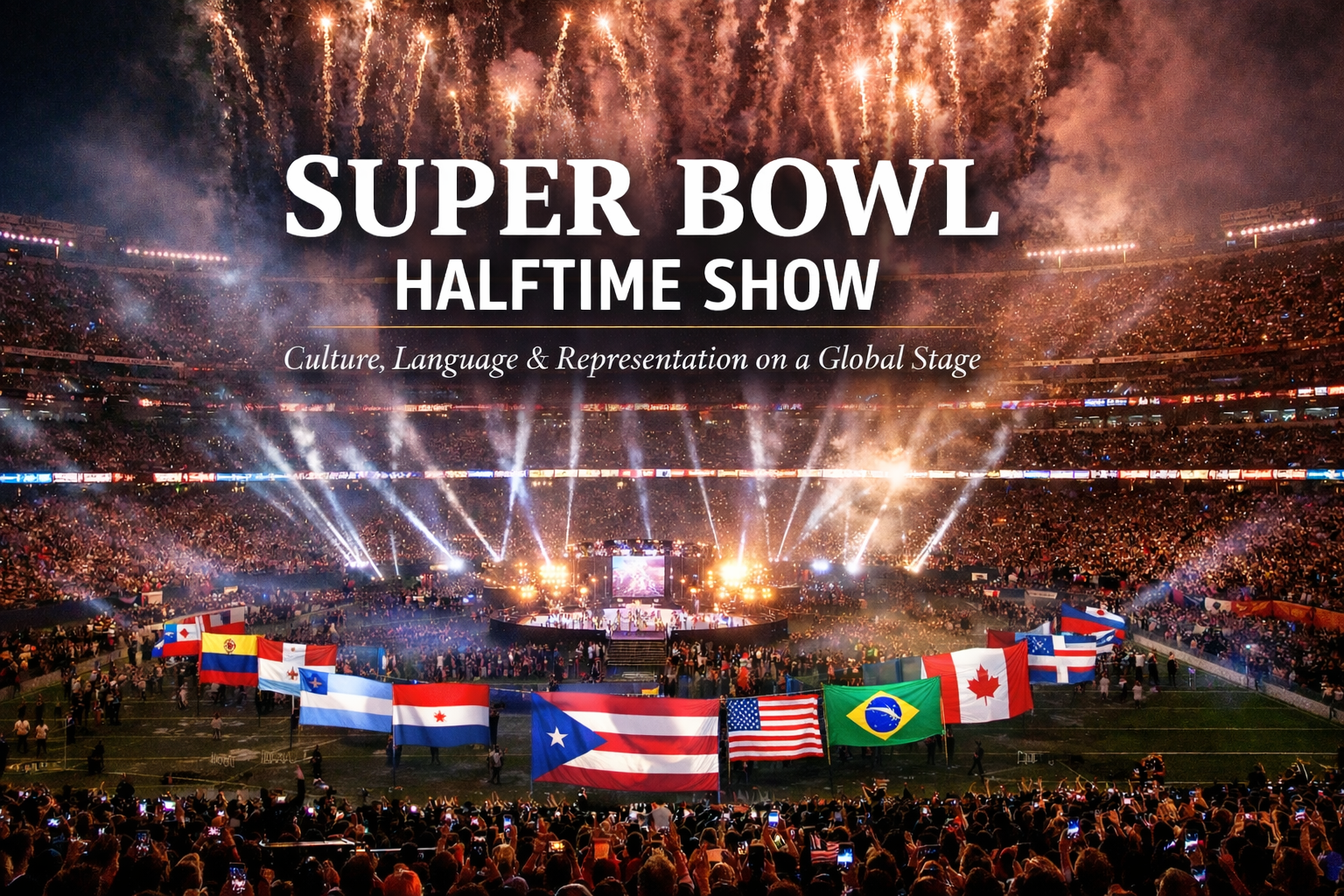
Embed from Getty ImagesFrom there, the field transformed into a hemispheric visual. Nations from across the Americas entered in regional sequence: South America, Central America, the Caribbean, and North America, mapping the hemisphere in shared space.
Chile, Argentina, Uruguay, Paraguay, Bolivia, Peru, Ecuador, Brazil, Colombia, Venezuela, Panama, Costa Rica, Nicaragua, Honduras, El Salvador, Guatemala, Mexico, Cuba, Dominican Republic, Jamaica, Puerto Rico, the United States, and Canada. The production placed every nation on the field without separation or rank. Together, they stood in shared formation at the same time.
Puerto Rico remained centered, culturally Latin American, politically tied to the United States, and historically linked to migration patterns that have shaped mainland cities for generations. The positioning required no explanation. It simply existed within the visual narrative.
Reaction and Cultural Impact
As the performance concluded, the closing screen delivered a direct message that love is stronger than hate, reinforcing unity as the show’s final thesis. Public reaction split quickly.
Soon after, criticism emerged from political spaces, including commentary from Donald Trump, who dismissed the performance and criticized the Spanish-language presentation. In response, the conversation expanded beyond music into questions of language, belonging, and national visibility.
The performance centered on the Spanish language. The visuals referenced labor history. The staging mapped the Americas in shared space. The production positioned Puerto Rico inside the American narrative without explanation or defense. Yet beyond analysis, one visual lingered longest, all the flags occupying the field at once. No separation. No tension.
Ultimately, the lasting image spoke to the broader Super Bowl Halftime Show cultural impact, unity visualized on one field. The imagery reflected a version of the world where shared roots carried more weight than borders.
The only thing more powerful than hate is love.








I really appreciate your perspective! His performance was historic and so much fun. Loved how it made everyone feel included and uplifted! 🎤
Thank you ! I appreciate you taking the time to read this. It was definitely one of those performances that extended beyond entertainment. Seeing how people connected to it across communities made the coverage even more meaningful to write.